Fabric & cutting / FREE CALCULATOR
Fabric shrinkage calculator
Compare a fabric sample before and after washing. Calculate lengthwise and widthwise shrinkage, then estimate the starting dimensions needed for your chosen finished size.
Make your calculation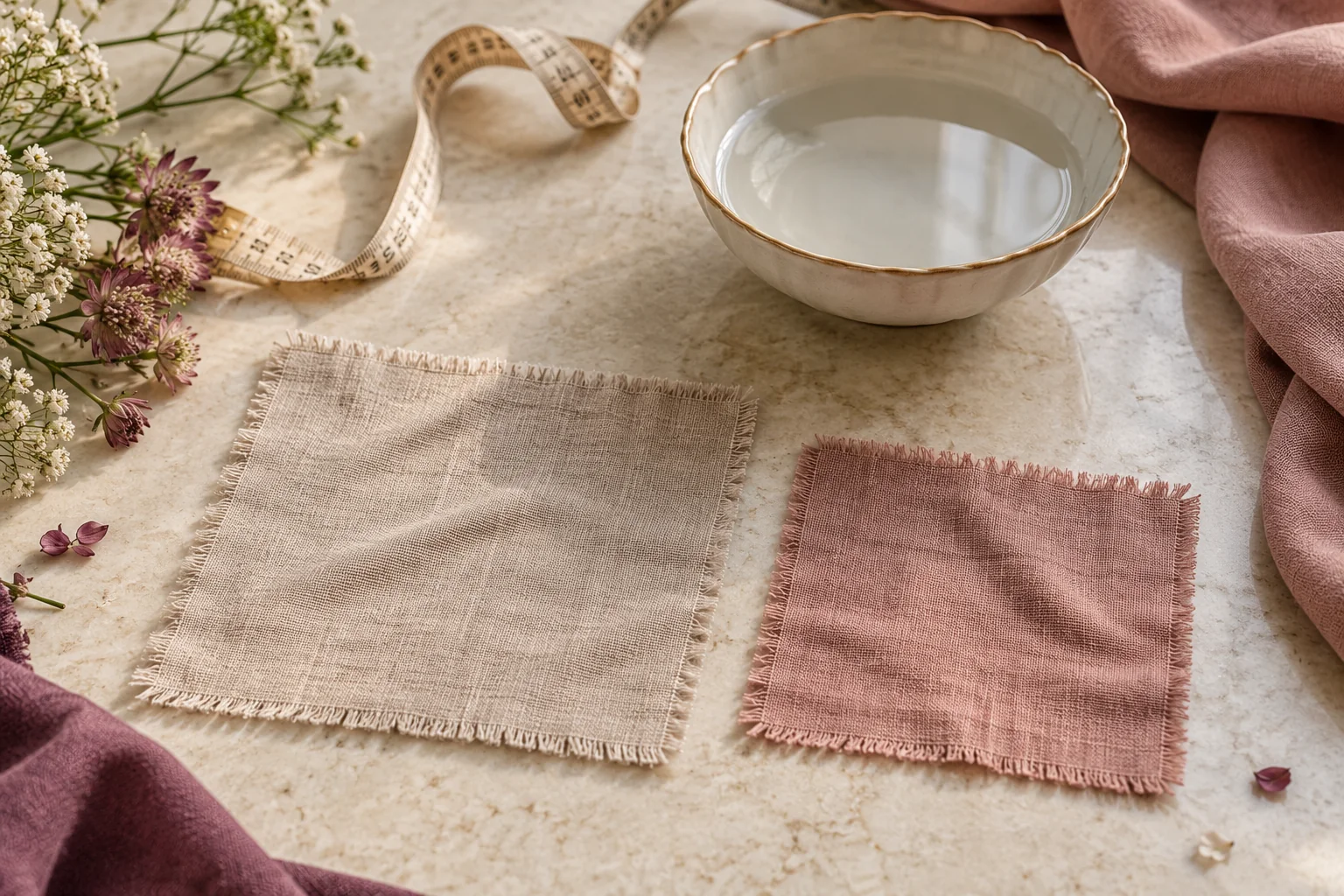
HOW IT WORKS
Mark and measure a sample along both grain directions.
Wash and dry it as intended, then measure again without stretching.
Enter the finished target to calculate its estimated starting size.
THE WORKING BEHIND THE NUMBER
A little more clarity.
THE METHOD
Shrinkage % = (before − after) ÷ before × 100. Starting dimension = target finished dimension ÷ (after ÷ before). Length and width are calculated separately.
Test the cloth you intend to use
Use a sample from the actual fabric and record which side follows the lengthwise grain. Measure the same marked points before and after your chosen care process. Let the sample dry and relax before taking the second measurement. Pulling it taut can hide a dimensional change.
The calculator keeps length and width separate because they may change differently. Your production estimate assumes the larger piece behaves like the sample under equivalent conditions; it does not predict a fibre’s shrinkage from its name.
Compensate by division
If a sample retains 96% of its length, the starting length for a 100 cm target is 100 ÷ 0.96, or about 104.17 cm. Simply adding 4% produces 104 cm and does not quite compensate for 4% loss on that larger starting piece.
A negative shrinkage percentage means the sample grew. Recheck orientation and measurement conditions before using that value. The result concerns fabric dimensions only: seam behaviour, lining differences and a finished garment’s construction may need separate testing.
A FEW USEFUL ANSWERS
Before you cut.
Why are length and width different?
Cloth can respond differently along its grain directions. Use both measurements instead of assuming one percentage applies everywhere.
Can the result be negative?
Yes. A negative shrinkage percentage means the measured sample became larger. Confirm it is dry, relaxed and measured at the same points.
Does this predict shrinkage without a sample?
No. It calculates the change you measured. Use the garment or fabric maker’s care instructions when preparing your test.