
Shape & detail / FREE CALCULATOR
Ruffle & gathering calculator
Turn a finished attachment length and fullness ratio into a practical ruffle cutting list. Include the strip depth, hem, joins and fabric width so the result matches the way you will sew.
Make your calculation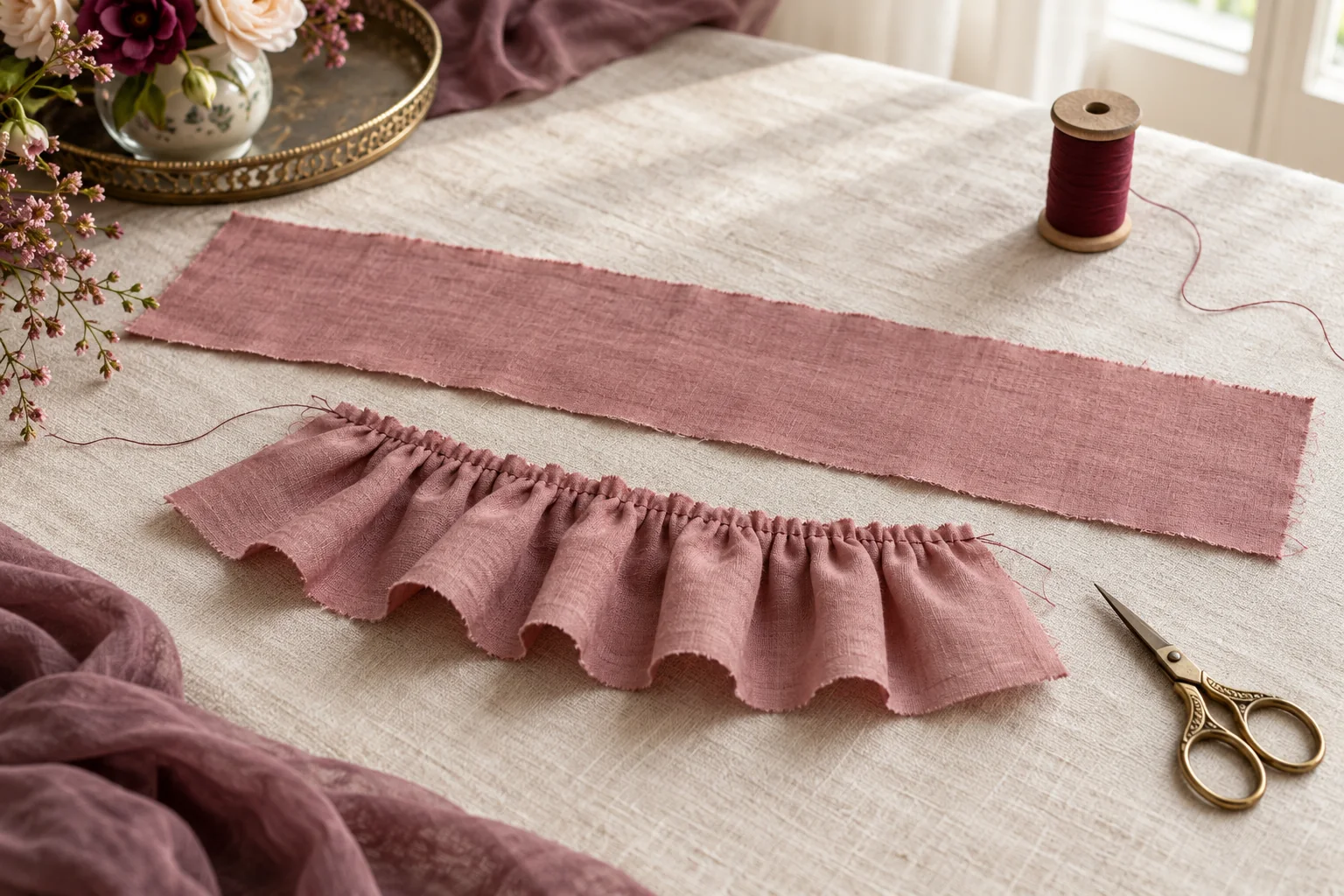
HOW IT WORKS
Measure the attachment edge and choose your fullness.
Add the depth and total allowances for the strip.
Cut the listed strip lengths, join them, then gather to the finished edge.
THE WORKING BEHIND THE NUMBER
A little more clarity.
THE METHOD
Joined strip before end finishing = attachment length × fullness + both outer-end allowances. Total cut length adds two joining allowances for every join. Cut-strip width = finished depth + top allowance + total hem allowance.
Define fullness at the sewing line
A fullness ratio compares the flat strip’s attachment length with the finished edge it will be gathered onto. A ratio of 2 means twice as much strip length before gathering. The ratio is your design choice and the examples do not prescribe a correct amount for every fabric.
Measure the attachment sewing line rather than adding an arbitrary margin around a curved cut edge. The calculator adds the two outer-end allowances and the joins separately, so you can see which parts will be consumed in sewing.
Use the cutting list
The plan cuts strips across the usable fabric width. Full-width strips come first and the final strip is shortened to the remaining required length. The calculator adds both ends of each join, then gives the total fabric length taken by the strip rows.
Enter the whole hem allowance, including every fold. The result does not include shrinkage, pattern matching or an additional margin for testing the gathered appearance. Make a short sample if the fabric weight or stiffness makes the final fullness uncertain.
A FEW USEFUL ANSWERS
Before you cut.
Is a 2:1 ratio always the right choice?
No. Fullness is a design decision influenced by fabric, depth and the effect you want. Compare a sample gathered at different ratios before committing to a long strip.
Are joins already included?
Yes. The calculator counts the strips needed and adds two seam allowances for each join, as well as the two outer-end allowances.
Does this calculate lengthwise or bias ruffles?
The cutting plan uses crosswise strips. A lengthwise or bias layout needs a different arrangement and may use a different amount of fabric.